On the quiet embarrassment of a brand that has not kept up, and what changes when it finally does.

There is a particular kind of discomfort that comes with having outgrown your brand. You know your work is good. You know the product is excellent, the service is considered, the years behind it are real. And yet something keeps you from sending people to your website without a small apology tucked into the message. Something makes you hesitate before handing over a business card, or before posting the thing you made, because the brand around it does not quite match the quality of what is inside it.
That gap, between where you are and where your brand says you are, is one of the most common things I encounter working with lifestyle brand founders. They have built something genuinely worth paying for. But the brand was made when the business was newer, smaller, less certain of itself. And it shows. Not always dramatically. Sometimes just in the way a potential customer hesitates, or asks a question the brand should have already answered, or chooses the competitor whose packaging communicated confidence first.
Branding is not decoration. It is the distance between what you have built and what the right person is able to see.
“The brand you launched with was right for where you were then. The question is whether it is still telling the truth about where you are now.”
Here is what that gap looks like in practice, and what closes when the brand finally catches up.
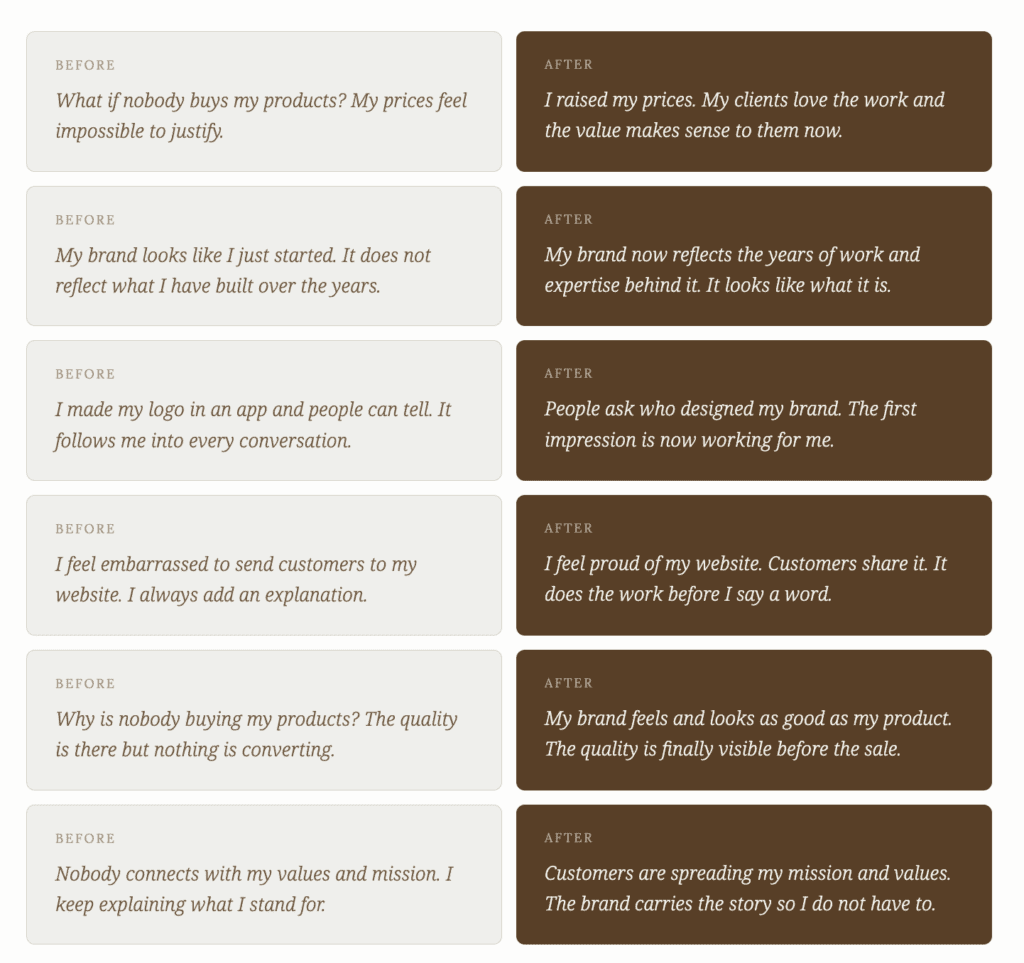
Six gaps that close when your brand finally reflects the business you have actually built.
You feel embarrassed to send customers to your website
This is the one most founders never say out loud. But it is there in the way you word your messages. Instead of just sharing the link, you add something around it. “It is still a work in progress.” “I am updating it soon.” “Ignore the homepage, just scroll down.” You have built a buffer between your customer and your brand because some part of you knows the website is not doing the business justice.
A website that works is one you send without thinking. It is the first place a new customer lands and feels the quality of what you do before she has even read a word. It communicates your positioning, your aesthetic, your story, and the specific person you are for, all in the first few seconds of arrival. When it does that well, customers do not just buy. They share. They send the link to a friend with a message that says, this is exactly what you have been looking for.
A website that does not do that is not just a missed opportunity. It is actively working against the business you have spent years building.

Customer Example
Ana had been running her botanical skincare studio for three years. Her formulations were meticulous, her clients were loyal, and her treatment philosophy was genuinely distinctive. But her website had been built quickly when she launched, and she had never gone back to it. The photography was inconsistent, the copy was generic, and nothing on the page communicated the depth of care that went into every product she made. Every time she gave someone her web address, she followed it with “it does not really show what we do yet.” When we rebuilt the site around her actual story, her sourcing philosophy, and the specific customer she had always been building for, something shifted. A customer she had never met found her through a shared link, booked a consultation, and became one of her highest spending regulars. The website had started doing the work she had been doing manually in every conversation.
Your product is good but nobody is buying it
This is the most frustrating place to be. You know the quality is there. You have put real time, real care, and real craft into what you make. And yet the sales are not reflecting it. So you wonder whether the price is wrong, whether the market is wrong, whether you are wrong. But most of the time, none of those things are wrong. The brand is wrong.
When a brand does not communicate the quality of the product it represents, the customer cannot see what she is actually paying for. She looks at the price and compares it to everything else that looks similar, even if nothing about the product is similar at all. She hesitates. She moves on. Not because she does not want what you make, but because the brand has not given her enough to feel confident about the decision.
A brand that works closes that gap before the customer even reaches the price. It communicates the sourcing, the craft, the intention, and the specific experience of owning the thing, so that by the time she sees the number, she already knows it is worth it. The product stops selling itself in spite of the brand and starts being carried by it.

Customer Example
Mia made small batch Filipino inspired preserves from heritage recipes that had been in her family for generations. The ingredients were carefully sourced, the process was slow and intentional, and every jar held something genuinely rare in the market she was selling into. But her packaging was simple kraft labels she had put together herself, and her product photography was shot on her phone in natural light. The jars looked homemade, which meant they were priced against homemade things. Customers who tried them always came back. The problem was getting them to try in the first place. When the packaging was redesigned to reflect the actual heritage and craft behind the product, the visual language finally matched the quality inside. She began stocking in a specialty grocer within four months. The product had not changed at all. What changed was what a customer could see before she opened the jar.
Nobody connects with your values and mission
For a founder who has built her business around a genuine purpose, a cultural story, or a set of values she has held since before the business existed, this is the most personal kind of disconnect. You did not build this just to sell things. You built it because you believed in something. And when customers come and go without ever engaging with that, without ever saying yes, this is exactly what I believe in too, it can feel like the most important part of what you are doing is invisible.
Most of the time, it is not that the mission is wrong or that no one cares. It is that the brand is not communicating it clearly enough, or visually enough, or consistently enough across every touchpoint for a customer to feel it rather than just read it. A mission statement on an about page is not brand storytelling. Brand storytelling is when the colours, the typography, the photography, the packaging, and the copy all point in the same direction and together create a feeling that the right customer immediately recognises as her own.
When that happens, customers do not just buy. They tell people. They share. They feel like they have found something that belongs to them, and they want other people who care about the same things to find it too. That is how a brand built on genuine purpose grows without spending everything on advertising. The customers become the story.
Customer Example
Sofia had built a sustainable womenswear label with a clear environmental philosophy at its centre. She talked about it in every caption, every interview, every conversation with a customer. But the brand itself, the visual identity, the packaging, the way the website was structured, did not reflect any of it. It looked like a fashion label. Not like a fashion label that stood for something specific. Customers bought because the clothes were beautiful. They rarely bought because they believed in what the brand was doing. When the identity was rebuilt around the actual values, the sourcing story, the materials, and the women the brand was designed for, something changed in how customers talked about it. They started tagging their friends. They started writing captions of their own about why they had chosen the brand. The mission had not changed. It had just finally become visible in the right places.
None of these changes happen because the logo got prettier. They happen because the brand finally tells the truth about the quality of the work, the depth of the expertise, and the specific person it is speaking to. When those things align, a customer does not need to be convinced. She arrives already certain.
If you recognised yourself in any of the before column, the hesitation, the explaining, the quiet embarrassment of sending someone somewhere you are not proud of, that is not a permanent condition. It is a gap. And gaps can be closed.
Your business has grown. Your brand should reflect that. INQUIRE HERE if you are ready to close the distance.
